Frits Dijcks interviewed me about the time I was coordinating Hoogtij, the art route of The Hague. His article about the history of Hoogtij is published on online art magazine Jegens & Tevens

visual artist
Frits Dijcks interviewed me about the time I was coordinating Hoogtij, the art route of The Hague. His article about the history of Hoogtij is published on online art magazine Jegens & Tevens
On February 20 in more than 100 cities worldwide International PechaKucha Day was held. I was invited to hold my PechaKucha talk about my Railway Photos on PechaKucha Night Leiden 30’s edition in Gebr. de Nobel.


Happy to announce that California based Analog Forever Magazine selected the first analog photo I took in years for their online winter exhibition.

Analog Forever Magazine showcases 56 images in their December 2019 Online Group Exhibition “Winter”, curated by Aline Smithson Photography of LENSCRATCH and sponsored by Lomography! These photographs explore the people, places, and memories that make the season of winter special in individual and creative ways. See all of the images selected for this exhibition at http://www.analogforevermagazine.com!


Artists from all over the world participate in this iconic exhibition in the very city center of Amsterdam. From South Africa to New Zealand, ages 20 to 80, all genders, world famous and starting: Marlene Dumas, TINKEBELL., Terry Rodgers, Silvia B, Sacha de Boer, Berend Strik, Sarah Maple, Hester Scheurwater, Anouk Griffioen, Max Kisman, Inge Aanstoot, Sylvana Simons, Barbara Broekman, Maxime Duvall, Liz Nielsen, to name a few. And me of course. So come and buy your artwork!
De Balie debate center
Kleine-Gartmanplantsoen 10
1017 RR Amsterdam, Netherlands
December 8-15, 2019
Opening reception December 8, 2019, 4-8pm.
Opening hours: Mon-Sun 10am-11pm
Finissage December 15, 2019, 4 pm.
Women on important positions like mayors, politicians, talk show hosts, musicians, all get a lot of sexist dirt thrown at them. Women are called hysterical, while men in the same situation are called bold….
It’s structural, it’s normalized, it’s everyday sexism.
This. Must. Stop.
That’s why Nasty Women Amsterdam strike again with a new smashing art exhibition & fundraiser in Amsterdam.
• Elance Academy: Girls inspire Women, Women inspire Girls
• Doctors of the World: Birth control consultation for undocumented women
BRING MONEY, BUY ART, BE GOOD

I’m happy to announce that Chicago-based F-Stop Magazine selected attached photo JAN for their current online exhibition. Jan is my neighbor who unfortunately died last year. I am proud that my colorful angel now has his place in photography heaven.
With the photo ‘Jan’ I won the NRC Photo Contest. The interview that came with it, was published on the website of the website of the national newspaper NRC.
The whole interview in Dutch:
„De fotograaf heeft een goede positie; door de vele details, krijg je echt een kijkje in iemands leven”, luidde het commentaar van de jury. En: „Hoe langer je kijkt, hoe meer je ziet. En hoe meer vragen het oproept.”
„Jan is mijn buurman in Leiden”, vertelt Lenny Waasdorp over haar winnende foto ‘Jan’. „Hij is 85. Negen jaar geleden is zijn vrouw overleden, sindsdien is hij alleen. Af en toe loop ik eens bij hem binnen; dan maken we een praatje en eten we samen wat. En soms vraag ik of ik een foto van hem mag nemen.”
„Vroeger handelde Jan in antiek. Hij houdt nog steeds van oude spulletjes. Maar laatst was hij gevallen met z’n scootmobiel. Daarom lag hij op bed, midden in de huiskamer. Ik had een icepack voor hem gehaald. Dat ligt op z’n enkel, onder de theedoek.”
Waasdorp volgde de Koninklijke Academie voor Beeldende Kunsten in Den Haag, studeerde aan de kunstacademie in Istanbul en deed nog een postacademische kunstopleiding. Ze wil zichzelf beslist geen fotograaf noemen. „Daarvoor mis ik de techniek. Ik ben volledig autodidact. Ik heb ook helemaal geen dure spullen. Ik heb geeneens een flits.”
Haar foto’s zijn beelden uit haar directe leefomgeving. „Dat is waar ik mijn inspiratie vandaan haal. Ik ga niet op zoek naar onderwerpen; de onderwerpen zijn er al. Op een gegeven moment krijg ik de behoefte om ze te fotograferen. Dat gebeurt organisch – óf het gebeurt niet.”
/s3/static.nrc.nl/inbeeld/files/2018/07/1-lenny.jpg)
Zo werkte Waasdorp een paar jaar parttime als conducteur op de trein. In die tijd maakte ze – met haar diensttelefoon – foto’s vanuit de achterste cabine. „Ik heb geprobeerd om de eindeloosheid van het spoorlandschap te laten zien, maar ook de eenzaamheid van het werken op het spoor. In die cabine mogen geen reizigers komen, daar zit je helemaal alleen. Dat was op dat moment mijn leefomgeving. Dan is het voor mij bijna logisch dat ik het ga fotograferen.” Het zwart-wit resultaat is te zien in het fotoboek ‘Station to Station to Station’.
Waasdorp maakte ook zelfportretten. 77 stuks, in kleur, in haar eigen studio. Geen mooie plaatjes, maar bewerkte, soms ook bewogen beelden met uitpuilende ogen, openhangende monden en gehavende neuzen. „Het was mijn zoektocht naar identiteit. Of je nu conducteur bent op de trein, of je drinkt thee met de buren, of je opent als kunstenaar een expositie: je bent het allemaal zelf, maar toch gedraag je je telkens anders en word je anders gezien. Dit was mijn manier om dat uit te zoeken.”
Een andere zoektocht leidde tot de fotoserie ‘See No Evil’. „Ik zag een filmpje over een Vlaamse seriemoordenaar. Die man was tekenleraar. Dat intrigeerde mij, want ik zat natuurlijk ook op de academie. En hij zat gewoon op een verjaardagsfeestje. Nergens gingen alarmbellen rinkelen. Logisch, want je kan aan de buitenkant niet zien wat iemand allemaal doet. Het kwaad heeft geen gezicht. Maar ik wilde weten hoe dat kwaad er dan toch uit zou kunnen zien.”
Dus vroeg ze familie, vrienden en mentoren van haar kunstopleiding of die voor haar wilden poseren. Ze fotografeerde hen met ontbloot bovenlijf en een nylonkous over hun hoofd. „Alsof ze criminelen waren. De typering van het kwaad.” Ze werkte hierbij met een pinhole camera, dus zonder lens, met slechts een klein lichtgaatje. „Die mensen moesten vijf minuten doodstil zo blijven zitten. Eigenlijk heb ik ze al die tijd gevangen gehouden. Het zouden dus net zo goed slachtoffers kunnen zijn. Dat is een mooie extra laag in de foto’s.”
„Mijn beelden tonen een beetje de rauwheid van het bestaan”, zegt Waasdorp. „Dat zie je terug in vrijwel al mijn werk, en eigenlijk ook in het portret van Jan. Het is een heel realistische foto.” Én ze houdt van series maken. Zoals ze deed met de zelfportretten en spoorlandschappen, maar bijvoorbeeld ook met boorplatformen. „Als je een aantal van dezelfde voorwerpen bij elkaar in een serie zet, worden het haast personen. Dan krijgen ze bijna een identiteit.”
Een serie van Jan, zit die eraan te komen? „Als hij het leuk vindt ga ik dat zeker doen. Jan is voor mij heel dichtbij. Dat vind ik toch wel het fijnst om te fotograferen.”

My photo “JAN” won the vakjuryprijs (professional jury prize) of the NRC Photo Competition. The professional jury consisted of: Wilfried de Jong, Sacha de Boer, Natalia Toret and Ilvy Njiokiktjien.
Titel: 28.11.2016 10.44 uur. Baanvak Ut-Ht. Dr. W. Hüpkesbrug bij Zaltbommel in SLT 2411. 16035
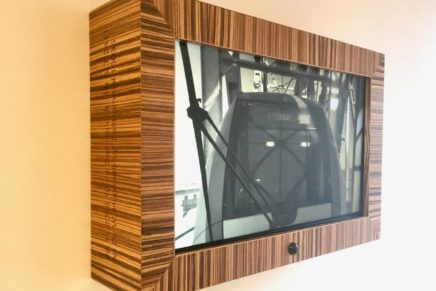
Since today, five of my works have been purchased by the Dutch Railways Head Office in Utrecht. These works have been developed for the Executive Board and are situated in their work and meeting spaces. All photos from these works are from the photo book Station to Station to Station. The beautiful wooden frames are made in cooperation with furniture maker Frida van der Poel.


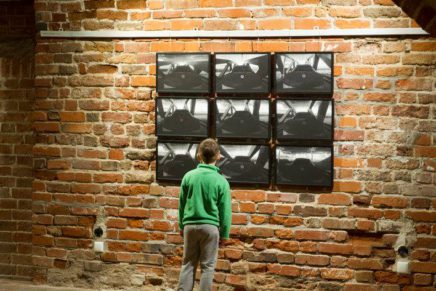
From July 5-12 I entered a exhibition in the District Museum of Toruń, Poland (Muzeum Okręgowe w Toruniu) with two works.
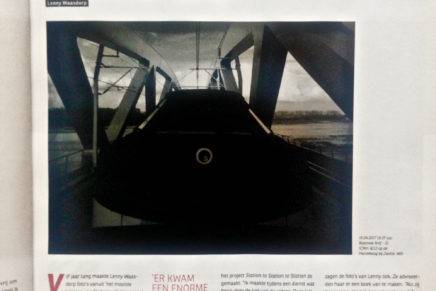
Above the serie: 16.04.2017 19:09 Section Amf – Zl ICMm 4213 on Hanzeboog Zwolle 665.

Interview for TVToruń.
Order Station to Station to Station at Lecturis
Station to Station to Station
A railroad movie
Five years ago I started working as a train manager at the Dutch Railways. I fell in love with the beauty of my new surroundings immediately. Because of my job, I was given access to the unmanned cabin at the rear end of the train that is off limits to visitors. My colleagues call this cabin: “The most beautiful office in the Netherlands’; the view is phenomenal. The sightlines, the tracks in perspective, the structures and textures all have a great magnetic effect. After a while I began to photograph from this rear end cabin. The photos provide an unpolished image of the view through the window of the cabin. The (disappearing) railway landscape mixes with the dirt, dead insects and raindrops on the window.

Distinctive
After shooting for five years, I have established a huge archive of images of which about 800 are included in Station to Station to Station. This book is distinctive for three reasons:

The endlessness of the track existence
Working on the track gives me the feeling of a raw romance. The endlessness of the track existence and the rawness are particularly well reflected in the long series of photos. A small number of self-portraits represent the loneliness and gives it a human scale compared to the panoramic, universal landscape. The different series range from 2 to 136 photos. The series are not displayed in chronological order but purely arranged to form. The individual photographs within the series are arranged according to their chronology.
The title Station to Station to Station indicates that what is photographed is positioned between stations, a parallel world that is invisible at first. I imagine the train as a spaceship that moves through this invisible world. At the stations the spaceship opens its doors, passengers step in, the doors close and when they get out they are in another time and in another place.
The repetition of the word station in the title is a cadence, a rhythm you physically experience also in trains. It’s the rhythm of time and space. Each traveller who travels from A to B will recognize this universal phenomenon. The unique position that I have as an artist and train manager, is used in a photo series that transforms the phenomenon mentioned above in a travel report: a journey that never ends. Thereby Station to Station to Station can also be interpreted as an intermediate station.
The design of this book is based on the rhythm of rail travel. A rhythm in intervals allowing a long series of photos to be interspersed with only a few pictures: like a train that slowly starts, accelerates and comes to a standstill. Consequently: browsing this 328-page book has the attention span that is a metaphor for travelling. The Swiss binding method releases the infrastructure of the book.

A meeting
One of the characteristics of Station to Station to Station is that all the photos were taken with a smartphone. Now these digitally made images are manifested in an analogously manner. Thus, this work of art is a hybrid wherein the shape (the book) gives weight to the content (smartphone pictures). It gets an extra layer of meaning because it is a meeting between the digital and analogue: an old medium that incorporates a new one.
The book enters a much more intimate relationship with the viewer through its shape than a display screen could ever do. Moreover it loosens itself from the huge, impersonal digital world. So this book, which reads like a railroad movie, becomes an invitation for a personal trip.

Order Station to Station to Station at Lecturis.


November 2016. Ten page’s in Vrij Nederland.

March 23: at BNR Nieuwsradio at the program HEMMEN: https://www.bnr.nl/player/

April 6 written article in Metro Holland, on- & offline.

April 12: a video made by Metro Holland.

April 28: article in Dutch Railway staff magazine.

June 7. Leidsch Dagblad.

June 14. Radio interview by Pieter van der Wielen in VPRO’s Nooit Meer Slapen

June 16. Radio interview by Jan Mom in Opium op 4.

June 26. Written article in SHUTR.photomagazine.